The Ripple · The complete inaugural issue
A wider ripple.
All 12 pages of the finished magazine. Scroll to read, or jump to a page below.
For a closer look, open the PDF and zoom in. Each page also includes a text version.
Read the text of this page
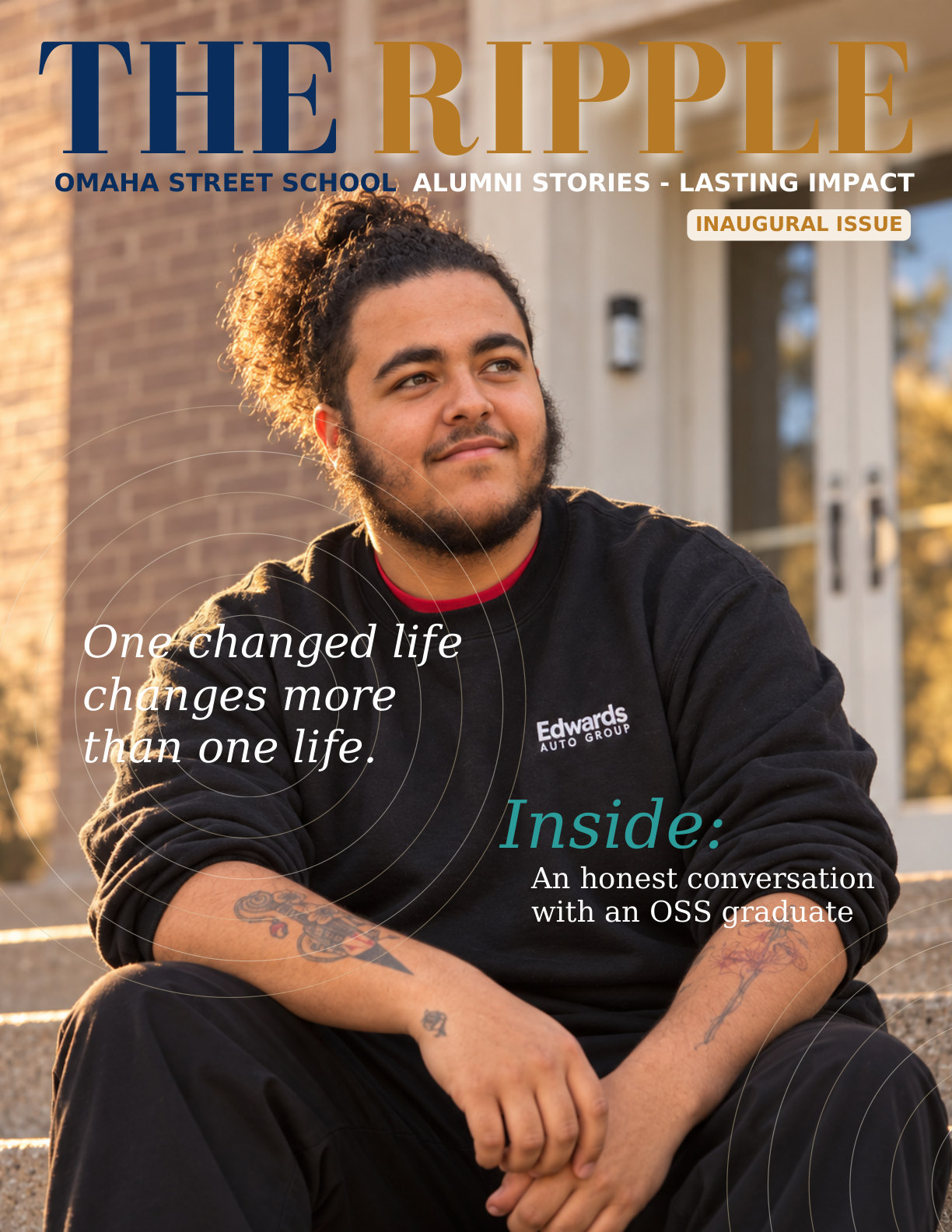
THE
THE RIPPLE
RIPPLE
OMAHA STREET SCHOOL
Inside:
An honest conversation
with an OSS graduate
ALUMNI STORIES - LASTING IMPACT
INAUGURAL ISSUE
One changed life
changes more
than one life.
Read the text of this page
It’s where the ripple begins.
P.S. Check out our new website for The Ripple Magazine at therippleoss.com.
THE RIPPLE
Imagine a student who graduates with a 2.3 GPA. By traditional measures, that number may not turn
many heads.
But now imagine that same student earns state certification as a CNA. She gets a job and shows up every
day. A year later, she is still working. She pays her bills. She has healthy relationships. She knows how to
ask for help. She gives back to others. And perhaps most importantly, she has something she may not
have had when she first walked through our doors: Hope for her future.
This is why we created The Ripple. Graduation isn’t the end of an Omaha Street School story.
PAGE 1
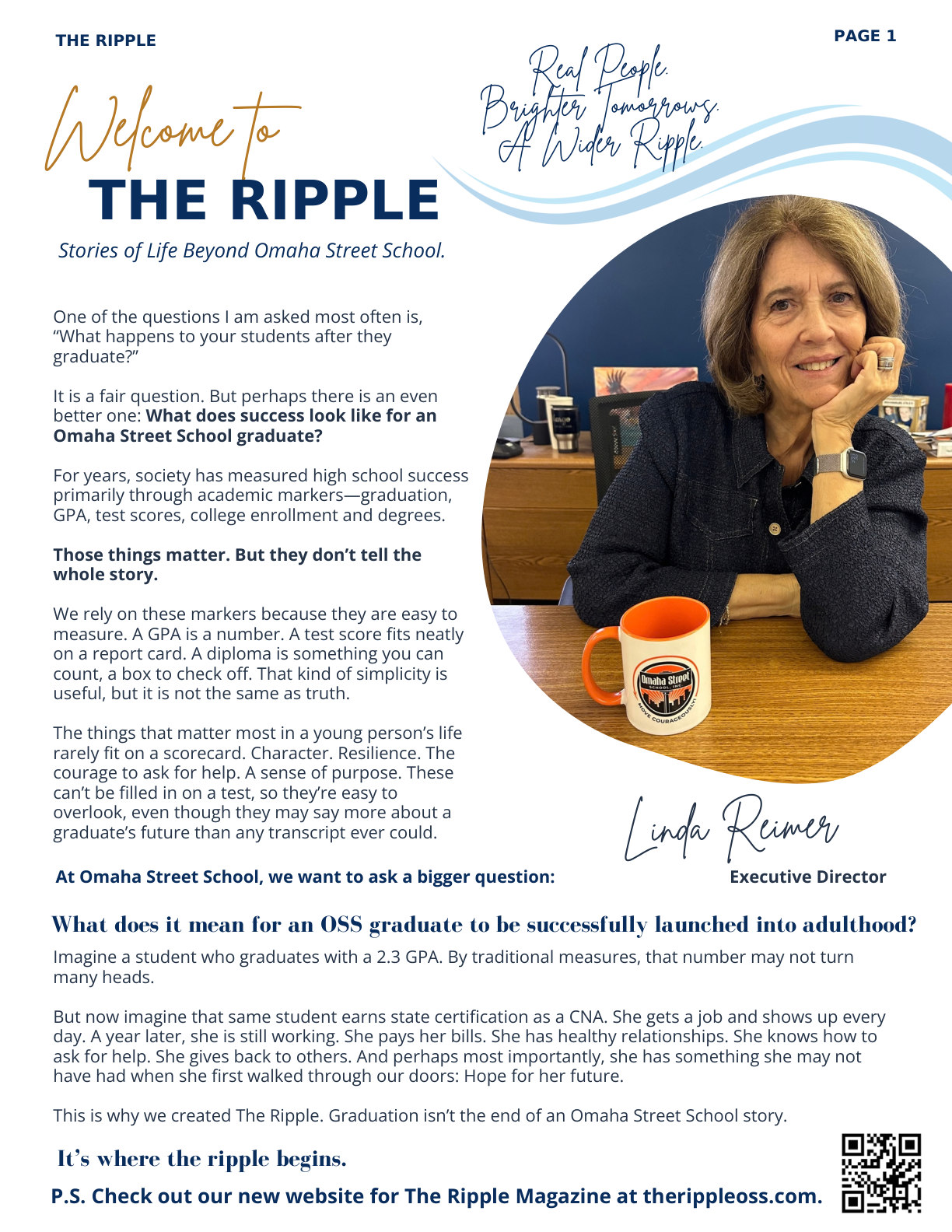
Welcome to
THE RIPPLE
Stories of Life Beyond Omaha Street School.
Real People.
Brighter Tomorrows.
A Wider Ripple.
One of the questions I am asked most often is,
“What happens to your students after they
graduate?”
It is a fair question. But perhaps there is an even
better one: What does success look like for an
Omaha Street School graduate?
For years, society has measured high school success
primarily through academic markers—graduation,
GPA, test scores, college enrollment and degrees.
Those things matter. But they don’t tell the
whole story.
We rely on these markers because they are easy to
measure. A GPA is a number. A test score fits neatly
on a report card. A diploma is something you can
count, a box to check off. That kind of simplicity is
useful, but it is not the same as truth.
The things that matter most in a young person’s life
rarely fit on a scorecard. Character. Resilience. The
courage to ask for help. A sense of purpose. These
can’t be filled in on a test, so they’re easy to
overlook, even though they may say more about a
graduate’s future than any transcript ever could.
At Omaha Street School, we want to ask a bigger question:
What does it mean for an OSS graduate to be successfully launched into adulthood?
Linda Reimer
Executive Director
Read the text of this page
2
3
4
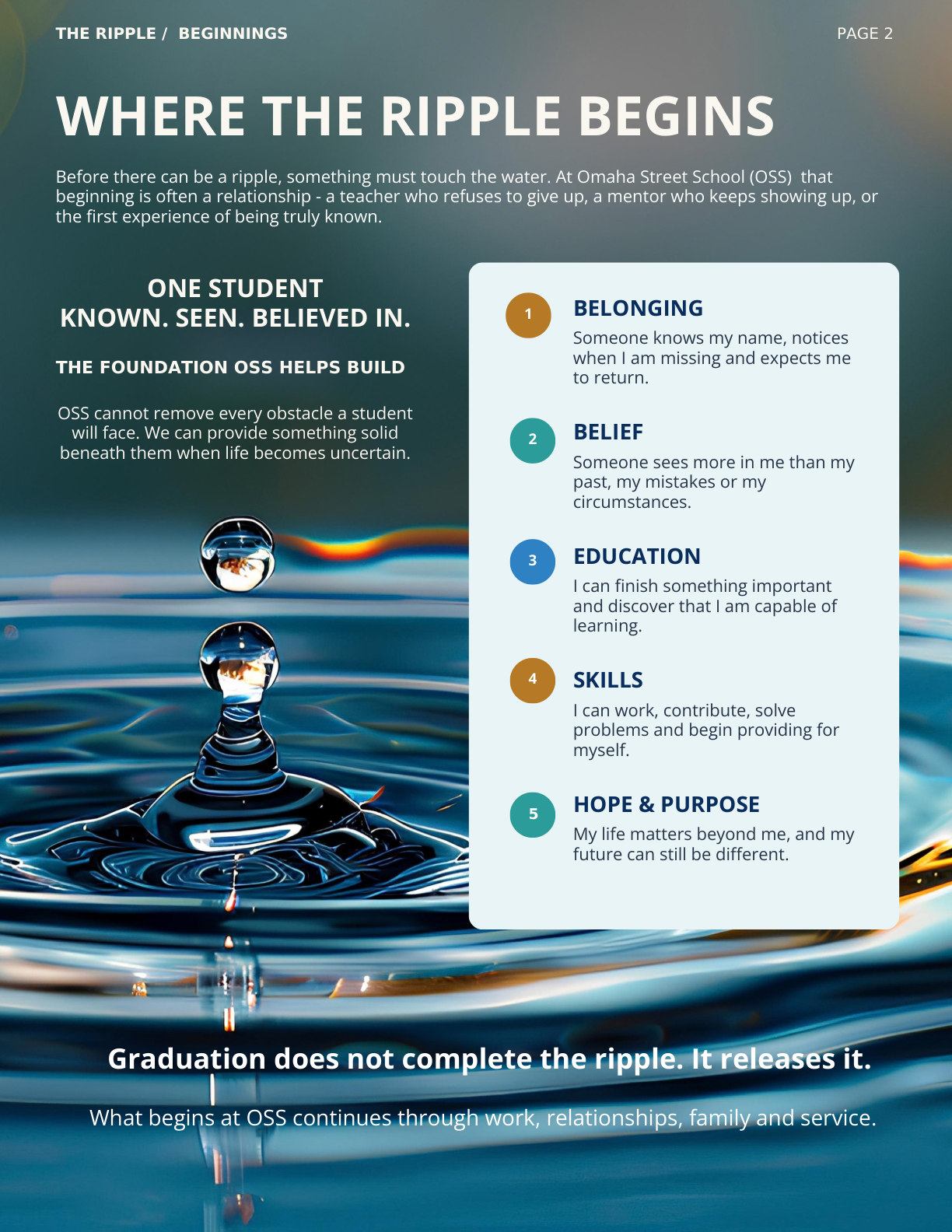
WHERE THE RIPPLE BEGINS
Before there can be a ripple, something must touch the water. At Omaha Street School (OSS) that
beginning is often a relationship - a teacher who refuses to give up, a mentor who keeps showing up, or
the first experience of being truly known.
ONE STUDENT
KNOWN. SEEN. BELIEVED IN.
OSS cannot remove every obstacle a student
will face. We can provide something solid
beneath them when life becomes uncertain.
THE FOUNDATION OSS HELPS BUILD
1
BELONGING
Someone knows my name, notices
when I am missing and expects me
to return.
BELIEF
Someone sees more in me than my
past, my mistakes or my
circumstances.
EDUCATION
I can finish something important
and discover that I am capable of
learning.
SKILLS
I can work, contribute, solve
problems and begin providing for
myself.
5
HOPE & PURPOSE
My life matters beyond me, and my
future can still be different.
Graduation does not complete the ripple. It releases it.
What begins at OSS continues through work, relationships, family and service.
THE RIPPLE / BEGINNINGS
PAGE 2
Read the text of this page
THE RIPPLE / FEATURED STORY
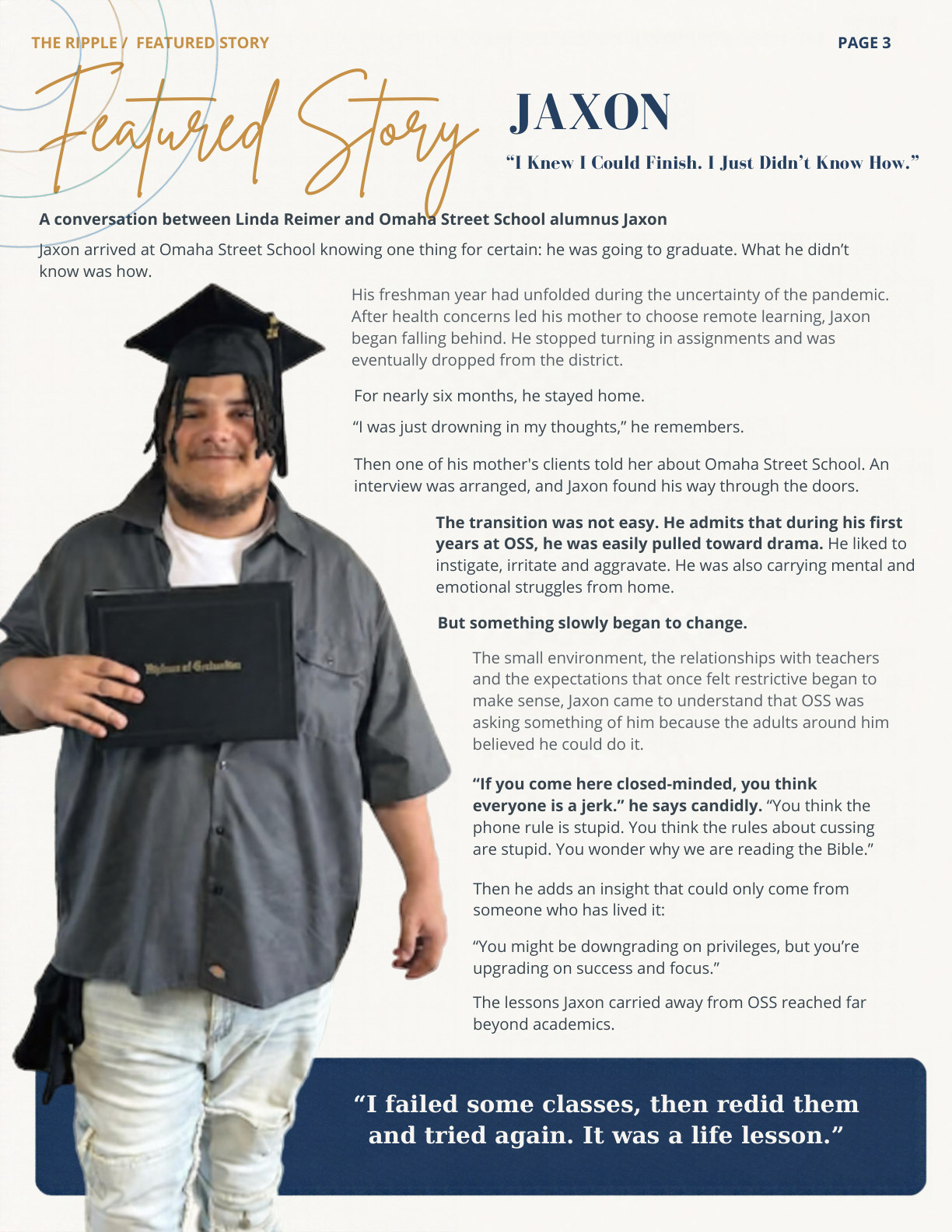
Featured Story JAXON
“I Knew I Could Finish. I Just Didn’t Know How.”
A conversation between Linda Reimer and Omaha Street School alumnus Jaxon
Jaxon arrived at Omaha Street School knowing one thing for certain: he was going to graduate. What he didn’t
know was how.
His freshman year had unfolded during the uncertainty of the pandemic.
After health concerns led his mother to choose remote learning, Jaxon
began falling behind. He stopped turning in assignments and was
eventually dropped from the district.
For nearly six months, he stayed home.
“I was just drowning in my thoughts,” he remembers.
Then one of his mother's clients told her about Omaha Street School. An
interview was arranged, and Jaxon found his way through the doors.
The transition was not easy. He admits that during his first
years at OSS, he was easily pulled toward drama. He liked to
instigate, irritate and aggravate. He was also carrying mental and
emotional struggles from home.
The small environment, the relationships with teachers
and the expectations that once felt restrictive began to
make sense, Jaxon came to understand that OSS was
asking something of him because the adults around him
believed he could do it.
“If you come here closed-minded, you think
everyone is a jerk.” he says candidly. “You think the
phone rule is stupid. You think the rules about cussing
are stupid. You wonder why we are reading the Bible.”
Then he adds an insight that could only come from
someone who has lived it:
“You might be downgrading on privileges, but you’re
upgrading on success and focus.”
The lessons Jaxon carried away from OSS reached far
beyond academics.
“I failed some classes, then redid them
and tried again. It was a life lesson.”
But something slowly began to change.
PAGE 3
Read the text of this page
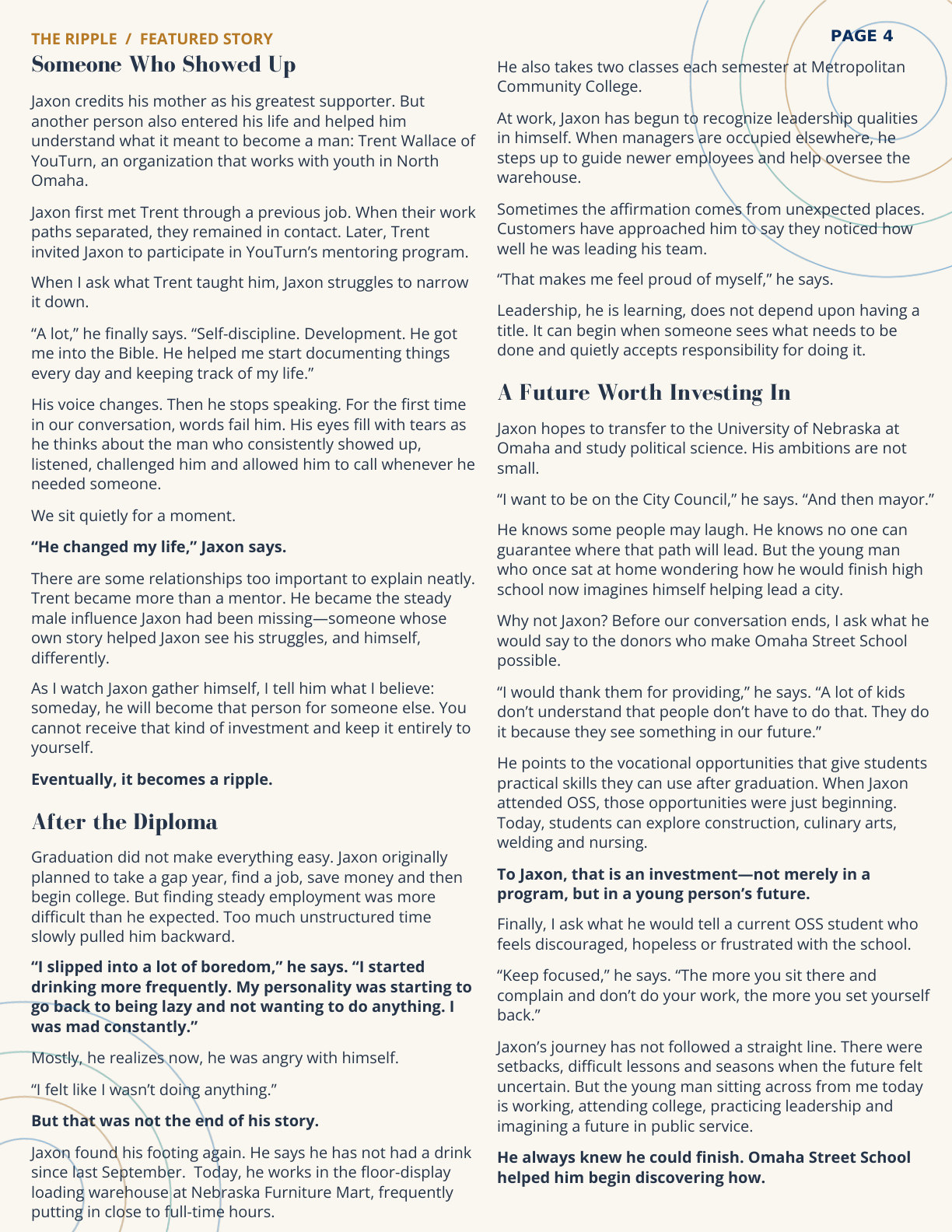
Someone Who Showed Up
Jaxon credits his mother as his greatest supporter. But
another person also entered his life and helped him
understand what it meant to become a man: Trent Wallace of
YouTurn, an organization that works with youth in North
Omaha.
Jaxon first met Trent through a previous job. When their work
paths separated, they remained in contact. Later, Trent
invited Jaxon to participate in YouTurn’s mentoring program.
When I ask what Trent taught him, Jaxon struggles to narrow
it down.
“A lot,” he finally says. “Self-discipline. Development. He got
me into the Bible. He helped me start documenting things
every day and keeping track of my life.”
His voice changes. Then he stops speaking. For the first time
in our conversation, words fail him. His eyes fill with tears as
he thinks about the man who consistently showed up,
listened, challenged him and allowed him to call whenever he
needed someone.
We sit quietly for a moment.
“He changed my life,” Jaxon says.
There are some relationships too important to explain neatly.
Trent became more than a mentor. He became the steady
male influence Jaxon had been missing—someone whose
own story helped Jaxon see his struggles, and himself,
differently.
As I watch Jaxon gather himself, I tell him what I believe:
someday, he will become that person for someone else. You
cannot receive that kind of investment and keep it entirely to
yourself.
Eventually, it becomes a ripple.
After the Diploma
Graduation did not make everything easy. Jaxon originally
planned to take a gap year, find a job, save money and then
begin college. But finding steady employment was more
difficult than he expected. Too much unstructured time
slowly pulled him backward.
“I slipped into a lot of boredom,” he says. “I started
drinking more frequently. My personality was starting to
go back to being lazy and not wanting to do anything. I
was mad constantly.”
Mostly, he realizes now, he was angry with himself.
“I felt like I wasn’t doing anything.”
But that was not the end of his story.
Jaxon found his footing again. He says he has not had a drink
since last September. Today, he works in the floor-display
loading warehouse at Nebraska Furniture Mart, frequently
putting in close to full-time hours.
He also takes two classes each semester at Metropolitan
Community College.
At work, Jaxon has begun to recognize leadership qualities
in himself. When managers are occupied elsewhere, he
steps up to guide newer employees and help oversee the
warehouse.
Sometimes the affirmation comes from unexpected places.
Customers have approached him to say they noticed how
well he was leading his team.
“That makes me feel proud of myself,” he says.
Leadership, he is learning, does not depend upon having a
title. It can begin when someone sees what needs to be
done and quietly accepts responsibility for doing it.
A Future Worth Investing In
Jaxon hopes to transfer to the University of Nebraska at
Omaha and study political science. His ambitions are not
small.
“I want to be on the City Council,” he says. “And then mayor.”
He knows some people may laugh. He knows no one can
guarantee where that path will lead. But the young man
who once sat at home wondering how he would finish high
school now imagines himself helping lead a city.
Why not Jaxon? Before our conversation ends, I ask what he
would say to the donors who make Omaha Street School
possible.
“I would thank them for providing,” he says. “A lot of kids
don’t understand that people don’t have to do that. They do
it because they see something in our future.”
He points to the vocational opportunities that give students
practical skills they can use after graduation. When Jaxon
attended OSS, those opportunities were just beginning.
Today, students can explore construction, culinary arts,
welding and nursing.
To Jaxon, that is an investment—not merely in a
program, but in a young person’s future.
Finally, I ask what he would tell a current OSS student who
feels discouraged, hopeless or frustrated with the school.
“Keep focused,” he says. “The more you sit there and
complain and don’t do your work, the more you set yourself
back.”
Jaxon’s journey has not followed a straight line. There were
setbacks, difficult lessons and seasons when the future felt
uncertain. But the young man sitting across from me today
is working, attending college, practicing leadership and
imagining a future in public service.
He always knew he could finish. Omaha Street School
helped him begin discovering how.
PAGE 4
THE RIPPLE / FEATURED STORY
Read the text of this page
In their own words
THE RIPPLE / ALUMNI VOICES
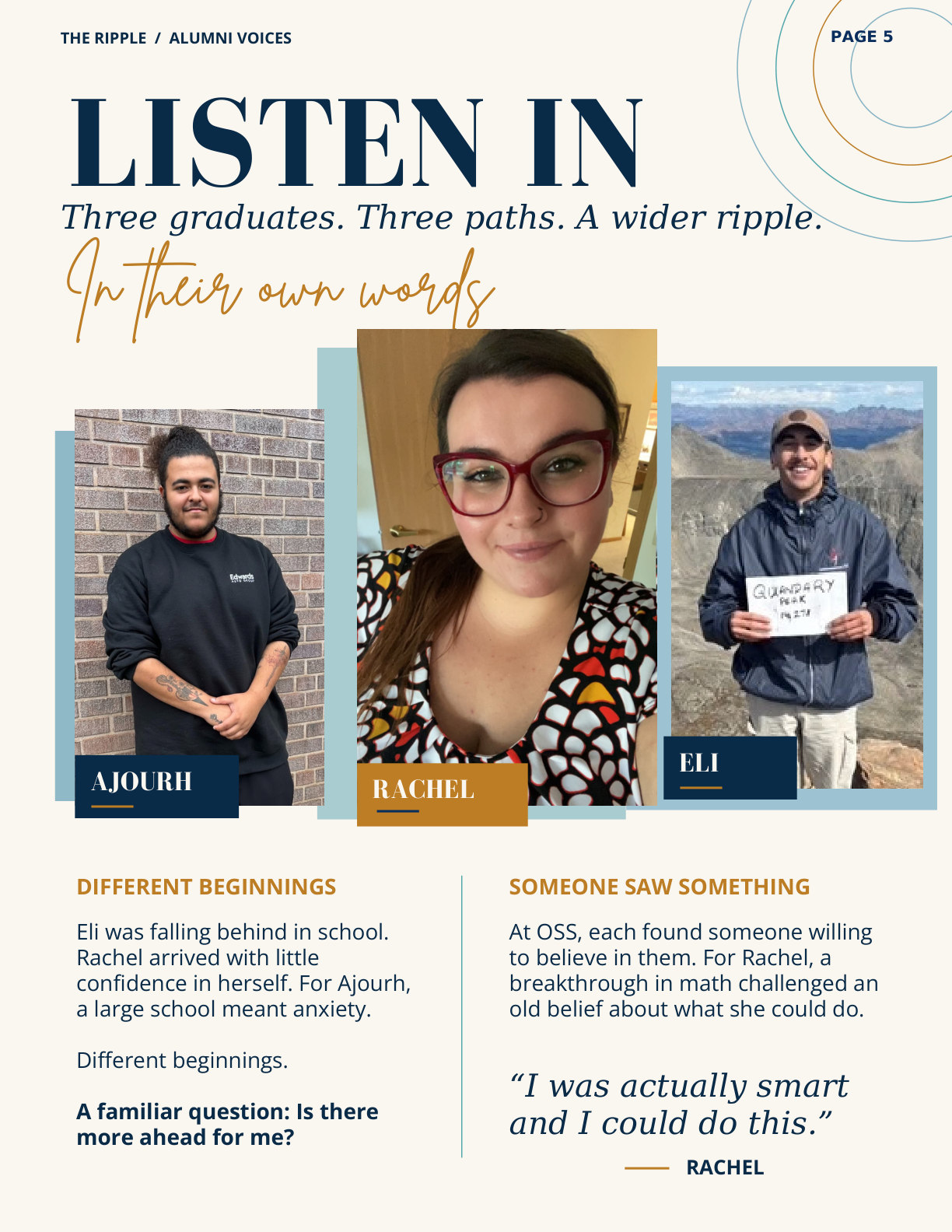
LISTEN IN
Three graduates. Three paths. A wider ripple.
AJOURH
RACHEL
ELI
DIFFERENT BEGINNINGS
Eli was falling behind in school.
Rachel arrived with little
confidence in herself. For Ajourh,
a large school meant anxiety.
Different beginnings.
A familiar question: Is there
more ahead for me?
SOMEONE SAW SOMETHING
At OSS, each found someone willing
to believe in them. For Rachel, a
breakthrough in math challenged an
old belief about what she could do.
“I was actually smart
and I could do this.”
RACHEL
PAGE 5
Read the text of this page
THE CONVERSATION CONTINUES
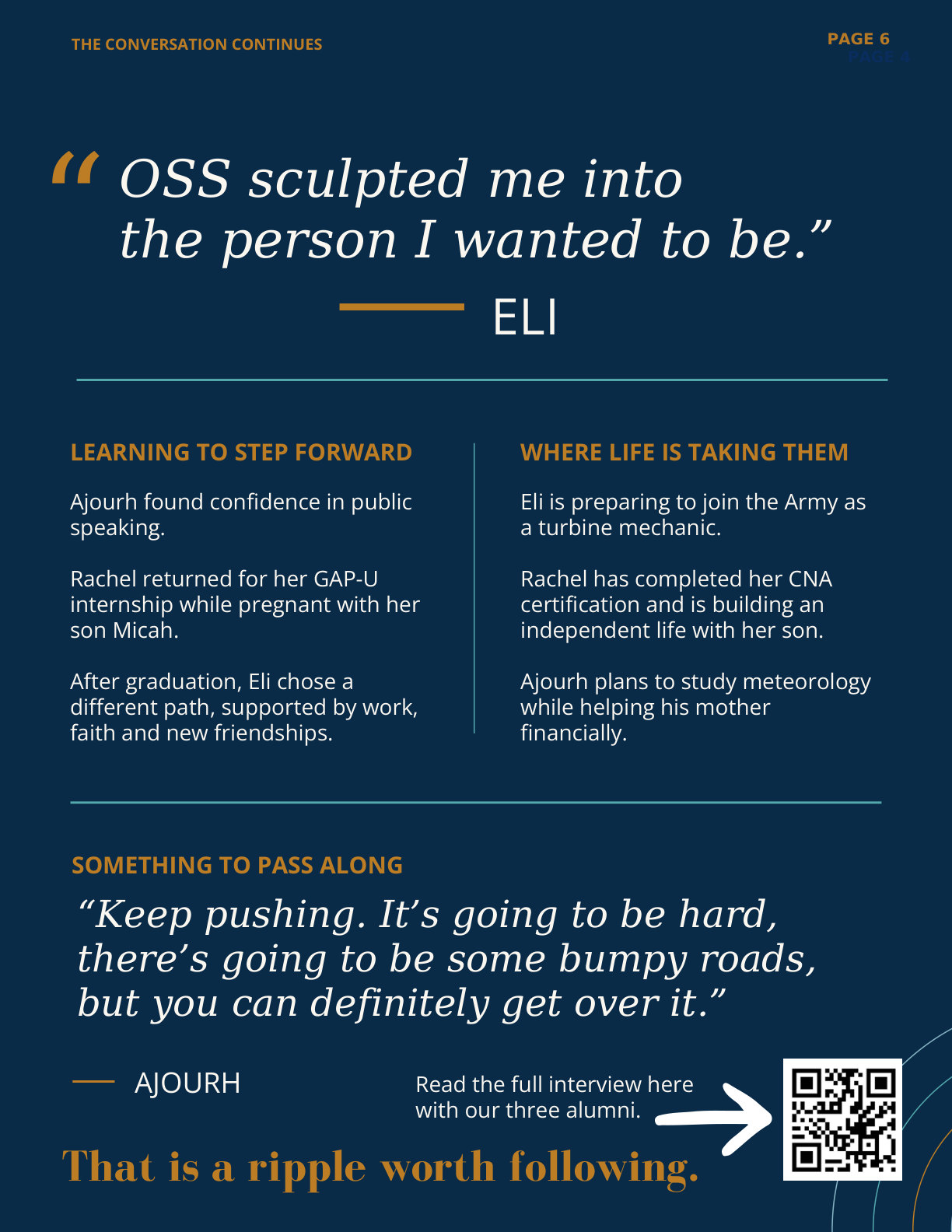
“
OSS sculpted me into
the person I wanted to be.”
ELI
LEARNING TO STEP FORWARD
Ajourh found confidence in public
speaking.
Rachel returned for her GAP-U
internship while pregnant with her
son Micah.
After graduation, Eli chose a
different path, supported by work,
faith and new friendships.
WHERE LIFE IS TAKING THEM
Eli is preparing to join the Army as
a turbine mechanic.
Rachel has completed her CNA
certification and is building an
independent life with her son.
Ajourh plans to study meteorology
while helping his mother
financially.
SOMETHING TO PASS ALONG
“Keep pushing. It’s going to be hard,
there’s going to be some bumpy roads,
but you can definitely get over it.”
AJOURH
That is a ripple worth following.
PAGE 4
PAGE 6
Read the full interview here
with our three alumni.
Read the text of this page
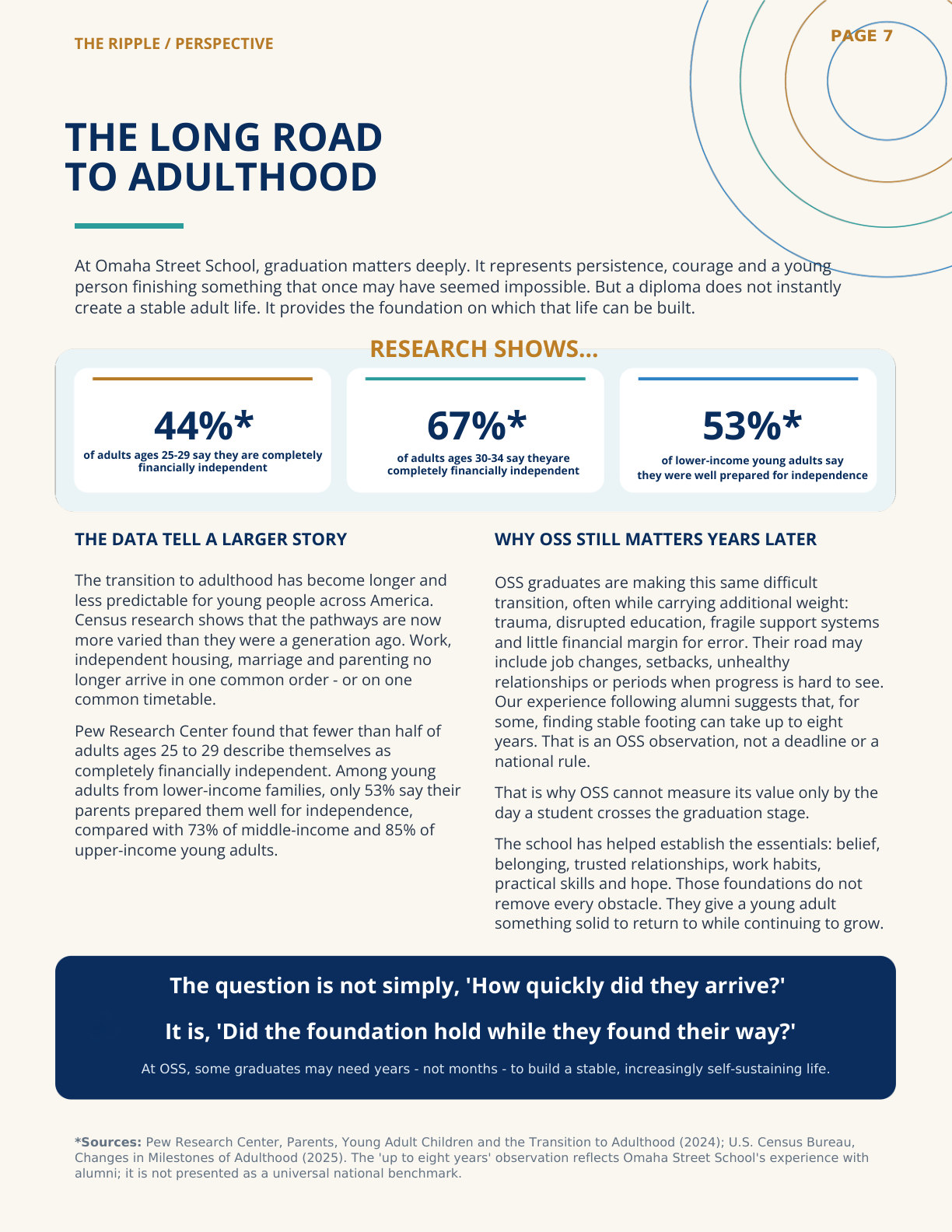
44%*
THE RIPPLE / PERSPECTIVE
THE LONG ROAD
TO ADULTHOOD
67%*
53%*
At Omaha Street School, graduation matters deeply. It represents persistence, courage and a young
person finishing something that once may have seemed impossible. But a diploma does not instantly
create a stable adult life. It provides the foundation on which that life can be built.
of adults ages 25-29 say they are completely
financially independent
of adults ages 30-34 say theyare
completely financially independent
of lower-income young adults say
they were well prepared for independence
THE DATA TELL A LARGER STORY
The transition to adulthood has become longer and
less predictable for young people across America.
Census research shows that the pathways are now
more varied than they were a generation ago. Work,
independent housing, marriage and parenting no
longer arrive in one common order - or on one
common timetable.
Pew Research Center found that fewer than half of
adults ages 25 to 29 describe themselves as
completely financially independent. Among young
adults from lower-income families, only 53% say their
parents prepared them well for independence,
compared with 73% of middle-income and 85% of
upper-income young adults.
WHY OSS STILL MATTERS YEARS LATER
OSS graduates are making this same difficult
transition, often while carrying additional weight:
trauma, disrupted education, fragile support systems
and little financial margin for error. Their road may
include job changes, setbacks, unhealthy
relationships or periods when progress is hard to see.
Our experience following alumni suggests that, for
some, finding stable footing can take up to eight
years. That is an OSS observation, not a deadline or a
national rule.
That is why OSS cannot measure its value only by the
day a student crosses the graduation stage.
The school has helped establish the essentials: belief,
belonging, trusted relationships, work habits,
practical skills and hope. Those foundations do not
remove every obstacle. They give a young adult
something solid to return to while continuing to grow.
The question is not simply, 'How quickly did they arrive?'
It is, 'Did the foundation hold while they found their way?'
At OSS, some graduates may need years - not months - to build a stable, increasingly self-sustaining life.
*Sources: Pew Research Center, Parents, Young Adult Children and the Transition to Adulthood (2024); U.S. Census Bureau,
Changes in Milestones of Adulthood (2025). The 'up to eight years' observation reflects Omaha Street School's experience with
alumni; it is not presented as a universal national benchmark.
RESEARCH SHOWS...
PAGE 7
Read the text of this page
THE RIPPLE / VOICES FROM THE BEGINNING
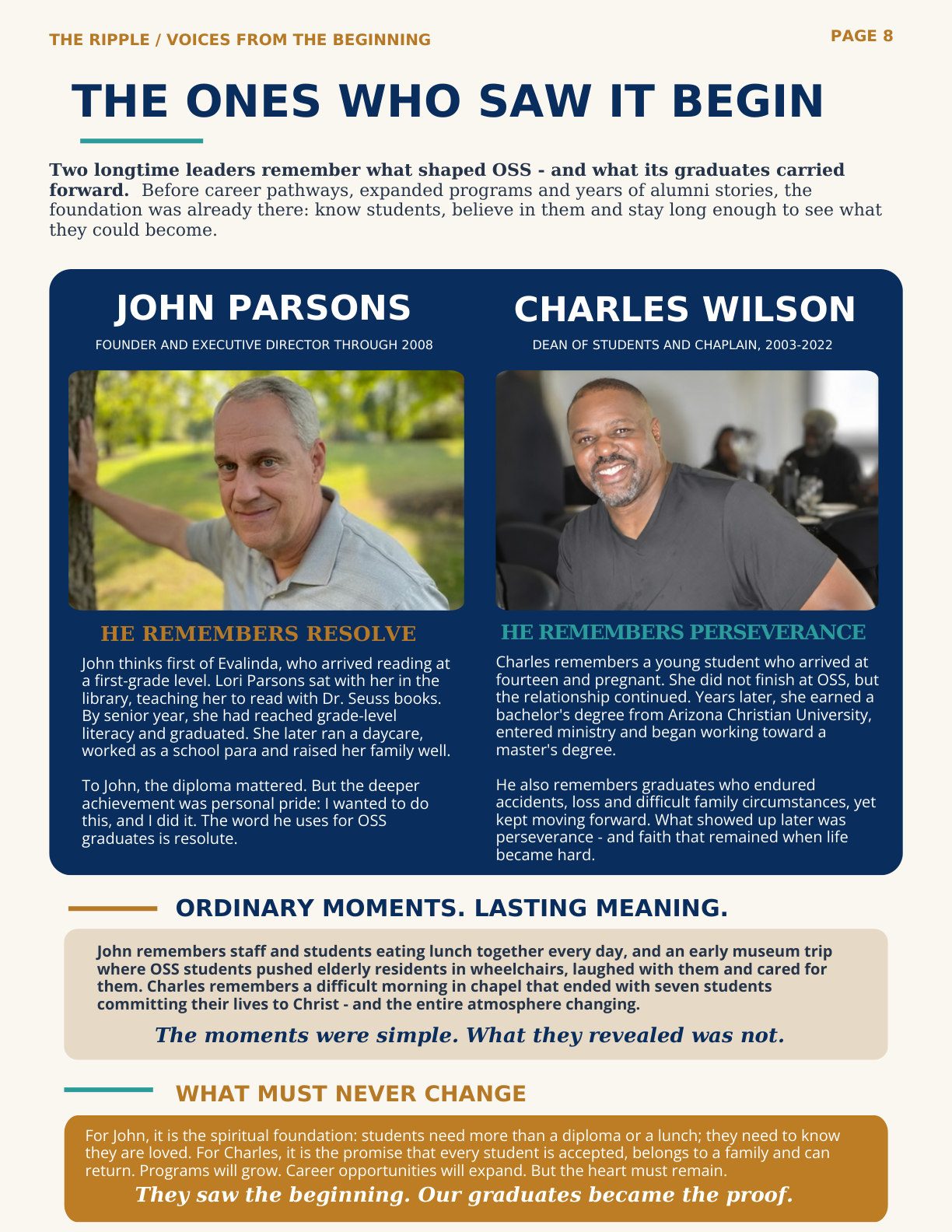
THE ONES WHO SAW IT BEGIN
Two longtime leaders remember what shaped OSS - and what its graduates carried
forward. Before career pathways, expanded programs and years of alumni stories, the
foundation was already there: know students, believe in them and stay long enough to see what
they could become.
JOHN PARSONS
FOUNDER AND EXECUTIVE DIRECTOR THROUGH 2008
HE REMEMBERS RESOLVE
John thinks first of Evalinda, who arrived reading at
a first-grade level. Lori Parsons sat with her in the
library, teaching her to read with Dr. Seuss books.
By senior year, she had reached grade-level
literacy and graduated. She later ran a daycare,
worked as a school para and raised her family well.
To John, the diploma mattered. But the deeper
achievement was personal pride: I wanted to do
this, and I did it. The word he uses for OSS
graduates is resolute.
CHARLES WILSON
DEAN OF STUDENTS AND CHAPLAIN, 2003-2022
HE REMEMBERS PERSEVERANCE
Charles remembers a young student who arrived at
fourteen and pregnant. She did not finish at OSS, but
the relationship continued. Years later, she earned a
bachelor's degree from Arizona Christian University,
entered ministry and began working toward a
master's degree.
He also remembers graduates who endured
accidents, loss and difficult family circumstances, yet
kept moving forward. What showed up later was
perseverance - and faith that remained when life
became hard.
ORDINARY MOMENTS. LASTING MEANING.
John remembers staff and students eating lunch together every day, and an early museum trip
where OSS students pushed elderly residents in wheelchairs, laughed with them and cared for
them. Charles remembers a difficult morning in chapel that ended with seven students
committing their lives to Christ - and the entire atmosphere changing.
The moments were simple. What they revealed was not.
WHAT MUST NEVER CHANGE
For John, it is the spiritual foundation: students need more than a diploma or a lunch; they need to know
they are loved. For Charles, it is the promise that every student is accepted, belongs to a family and can
return. Programs will grow. Career opportunities will expand. But the heart must remain.
They saw the beginning. Our graduates became the proof.
PAGE 8
Read the text of this page
THE RIPPLE / YOUR PART IN THE STORY
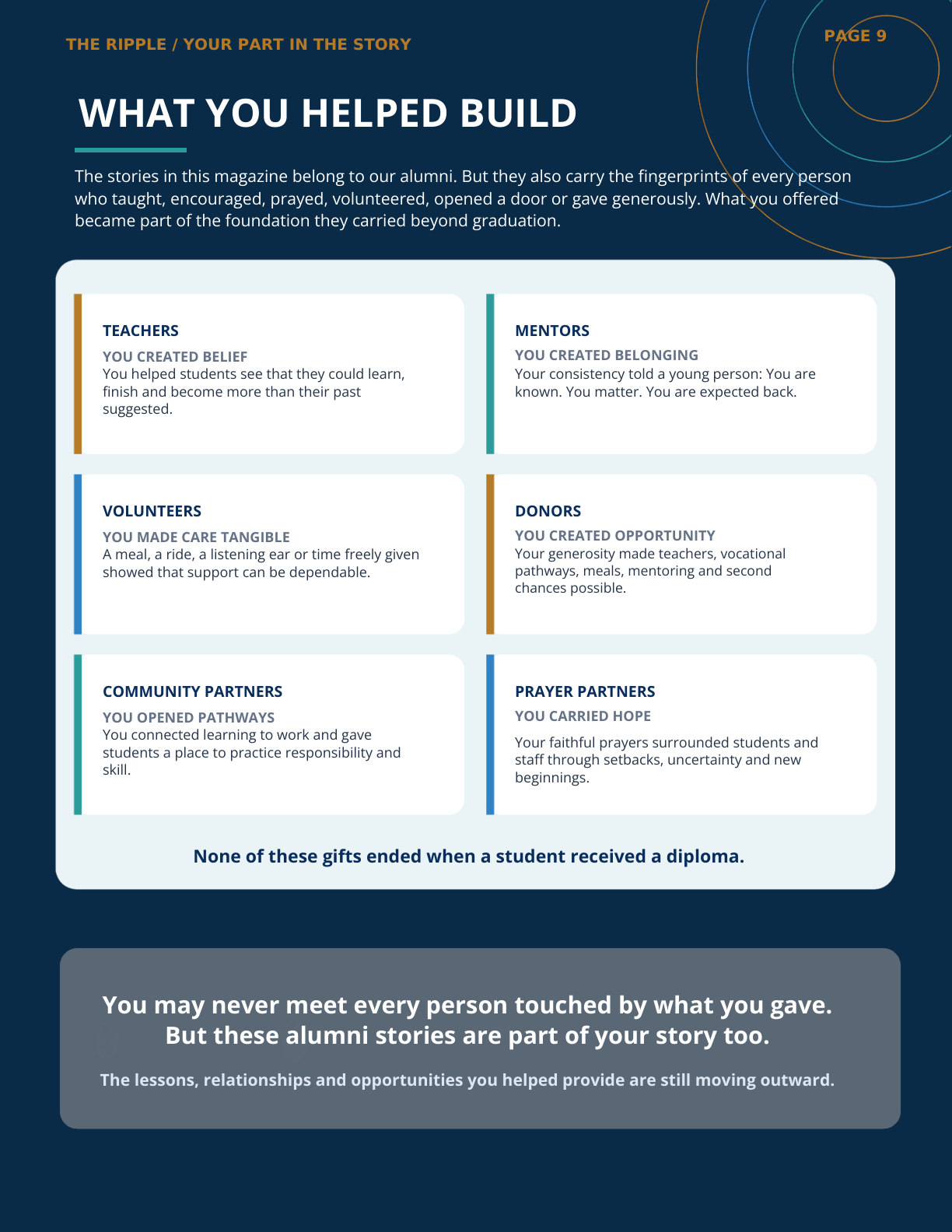
WHAT YOU HELPED BUILD
The stories in this magazine belong to our alumni. But they also carry the fingerprints of every person
who taught, encouraged, prayed, volunteered, opened a door or gave generously. What you offered
became part of the foundation they carried beyond graduation.
TEACHERS
VOLUNTEERS
COMMUNITY PARTNERS
DONORS
MENTORS
PRAYER PARTNERS
YOU CREATED BELIEF
You helped students see that they could learn,
finish and become more than their past
suggested.
YOU OPENED PATHWAYS
You connected learning to work and gave
students a place to practice responsibility and
skill.
YOU MADE CARE TANGIBLE
A meal, a ride, a listening ear or time freely given
showed that support can be dependable.
YOU CARRIED HOPE
YOU CREATED BELONGING
YOU CREATED OPPORTUNITY
Your generosity made teachers, vocational
pathways, meals, mentoring and second
chances possible.
Your faithful prayers surrounded students and
staff through setbacks, uncertainty and new
beginnings.
Your consistency told a young person: You are
known. You matter. You are expected back.
None of these gifts ended when a student received a diploma.
You may never meet every person touched by what you gave.
But these alumni stories are part of your story too.
The lessons, relationships and opportunities you helped provide are still moving outward.
PAGE 9
Read the text of this page
omahastreetschool.com
THE RIPPLE / AN INVITATION
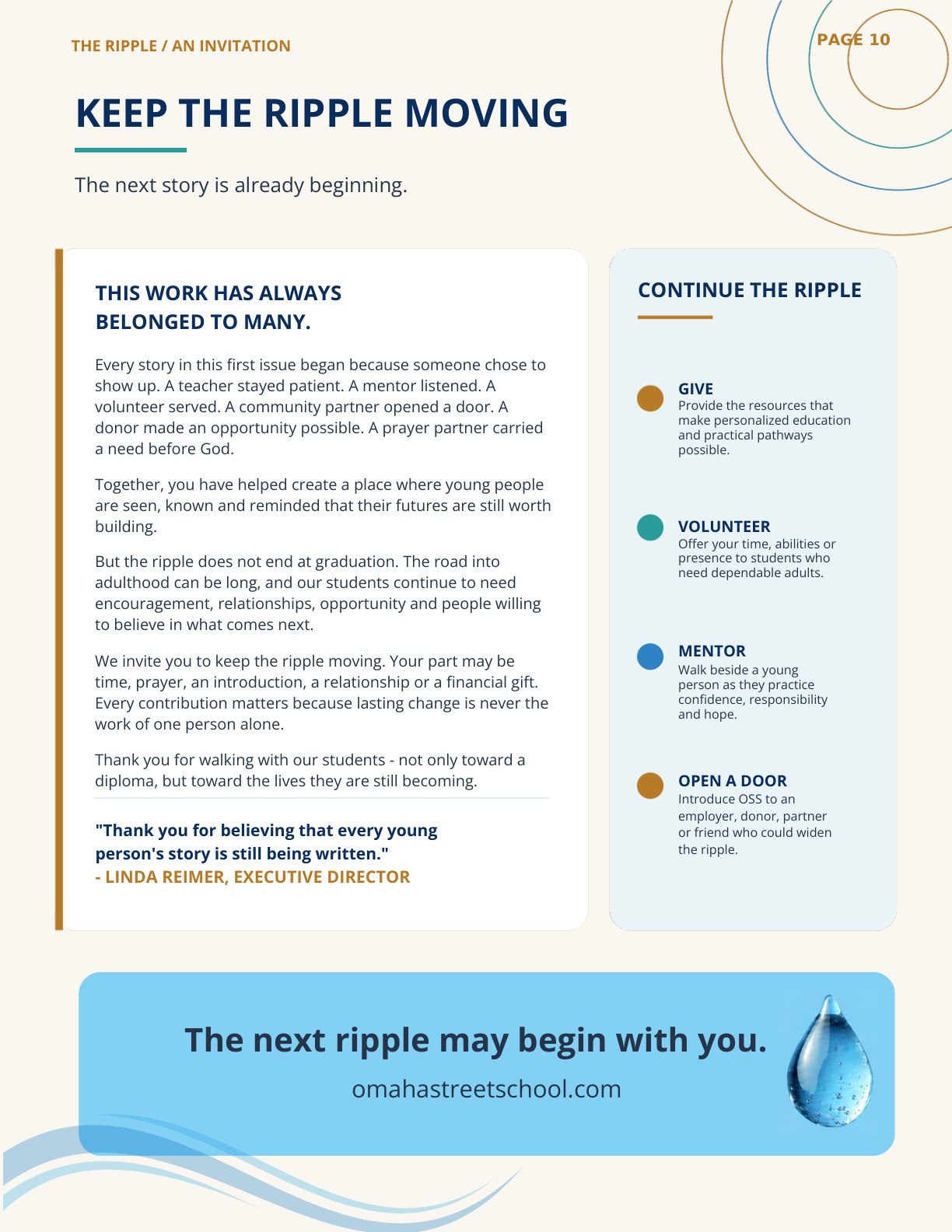
KEEP THE RIPPLE MOVING
The next story is already beginning.
THIS WORK HAS ALWAYS
BELONGED TO MANY.
GIVE
Provide the resources that
make personalized education
and practical pathways
possible.
MENTOR
VOLUNTEER
Offer your time, abilities or
presence to students who
need dependable adults.
OPEN A DOOR
Every story in this first issue began because someone chose to
show up. A teacher stayed patient. A mentor listened. A
volunteer served. A community partner opened a door. A
donor made an opportunity possible. A prayer partner carried
a need before God.
Together, you have helped create a place where young people
are seen, known and reminded that their futures are still worth
building.
But the ripple does not end at graduation. The road into
adulthood can be long, and our students continue to need
encouragement, relationships, opportunity and people willing
to believe in what comes next.
We invite you to keep the ripple moving. Your part may be
time, prayer, an introduction, a relationship or a financial gift.
Every contribution matters because lasting change is never the
work of one person alone.
Thank you for walking with our students - not only toward a
diploma, but toward the lives they are still becoming.
"Thank you for believing that every young
person's story is still being written."
- LINDA REIMER, EXECUTIVE DIRECTOR
CONTINUE THE RIPPLE
Introduce OSS to an
employer, donor, partner
or friend who could widen
the ripple.
Walk beside a young
person as they practice
confidence, responsibility
and hope.
The next ripple may begin with you.
PAGE 10
Read the text of this page
Omaha Street School
3223 N 45th Street, Omaha, NE 68104
(402) 451-5234 | omahastreetschool.com